
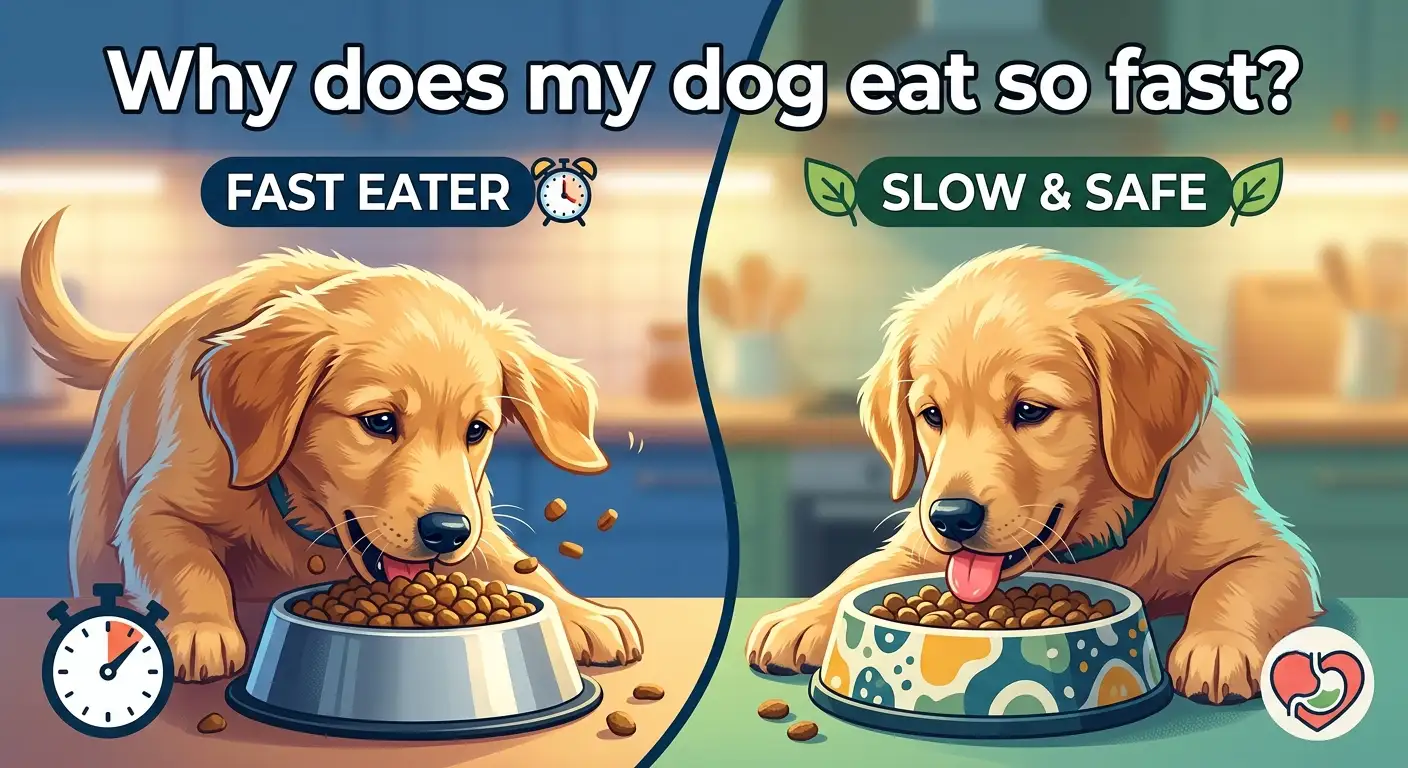
If your dog finishes a full bowl of food in under thirty seconds, you are not alone. Many dogs eat at a speed that looks more like a race than a meal. The behavior is common, but that does not mean it is harmless. Understanding why it happens is the first step to slowing things down safely.
Common Reasons Dogs Eat Too Quickly
Speed eating rarely comes out of nowhere. Most of the time, one of these underlying causes is behind it.
Survival Instinct
Dogs are descended from animals that competed for food. In the wild, eating fast meant eating before another animal could take the meal. Even well-fed domestic dogs can carry this instinct. It is hardwired rather than learned, which means no amount of training will eliminate it entirely on its own.
Competition with Other Pets
In multi-pet households, a dog may speed up at mealtimes simply because another animal is nearby. Even if the other pet never approaches the bowl, the presence alone can trigger faster eating. Dogs often eat as if every meal might disappear at any moment.
Anxiety or Stress
Dogs experiencing general anxiety, separation anxiety, or stress around feeding routines may eat quickly as a coping behavior. Mealtime can feel unpredictable to an anxious dog, which accelerates eating as a form of self-soothing.
Breed Tendencies
Some breeds are more prone to food-motivated behavior than others. Labrador Retrievers, Beagles, Golden Retrievers, and Pugs are consistently reported by owners as faster eaters. If your dog is one of these breeds, fast eating is especially worth addressing early.
Irregular Feeding Schedules
Dogs that go long stretches without food, or that have experienced food scarcity earlier in life (particularly rescues), may eat extremely fast because they have learned not to rely on the next meal appearing on time. Establishing a consistent feeding routine can help, though it rarely resolves the speed entirely.
Health Risks of Eating Too Fast
Fast eating is not simply an aesthetic issue. Several health problems are directly linked to it.
Bloat (Gastric Dilatation-Volvulus)
Bloat, clinically known as gastric dilatation-volvulus or GDV, is the most serious risk. When a dog eats and drinks rapidly, it swallows large amounts of air. That air can cause the stomach to expand and, in severe cases, to twist on itself. GDV is a veterinary emergency that can be fatal within hours. It is more common in large, deep-chested breeds such as Great Danes, German Shepherds, and Standard Poodles, but any dog can be affected.
Vomiting and Regurgitation
A dog that eats too fast frequently brings food back up shortly after a meal. This happens because the stomach is overwhelmed before it can process the volume properly. Repeated regurgitation puts strain on the esophagus and can lead to more chronic digestive issues over time.
Choking
Kibble swallowed in large chunks rather than chewed properly is a choking hazard, particularly in smaller dogs. This risk increases when a dog is eating with excitement and minimal attention to chewing.
Poor Nutrition Absorption
When food moves through the digestive system too quickly, the body has less opportunity to absorb nutrients properly. A dog can eat an appropriate amount of food and still be malnourished if it is not spending enough time digesting each meal.
⚠️ Vet Note
If your dog vomits after most meals, appears bloated after eating, or shows signs of abdominal discomfort, speak to your vet promptly. These symptoms warrant a professional evaluation rather than a home solution alone.
What a Slow Feeder Bowl Actually Does
A slow feeder bowl is designed with raised ridges, mazes, or dividers built into the surface. Instead of being able to take large mouthfuls, a dog has to work around the obstacles to access food. This mechanically forces the pace of eating to slow down without requiring any training or willpower from the dog.
Most dogs adapt to a slow feeder within a few meals. The design also provides a mild form of mental stimulation because the dog has to use its nose and tongue to navigate the bowl, which adds a small enrichment element to mealtime. Slow feeders are available in sizes suited to small dogs right up to large breeds, and in versions designed for both dry and wet food.
They are one of the most straightforward and low-cost interventions available for fast eaters. If you want to explore the options, our guide to the covers is the best slow feeder dog bowl across different sizes and budgets.
Other Ways to Slow Down a Fast-Eating Dog
Slow feeders work well, but they are not the only option. The following approaches can be used alongside a slow feeder or on their own.
- Divide meals into smaller portions. Instead of one large meal, feeding two or three smaller meals across the day reduces how hungry your dog is at each sitting, which naturally reduces urgency.
- Hand feeding. Offering small handfuls one at a time controls portion size precisely and turns mealtime into a bonding activity. It is time-consuming but effective for dogs that eat extremely fast.
- Scatter feeding on a mat or the floor. Spreading kibble across a flat surface forces a dog to forage rather than gulp. Licki mats work well for wet food or food mixed with a little broth.
- Add water or broth to dry food. Soaking kibble before serving softens it and makes large gulps harder to take. It also slows the pace slightly as the food becomes more liquid.
- Use a muffin tin. Dividing a portion of food across the compartments of a regular muffin tin is a free alternative to a purpose-built slow feeder.
- Separate dogs at mealtimes. If competition between pets is driving the speed, feeding in separate rooms removes that trigger immediately.
When to Talk to Your Vet
Most cases of fast eating can be managed at home with the methods above. However, there are situations where a vet conversation is the right move.
- Your dog vomits after most meals, not just occasionally.
- You notice a visibly distended abdomen after eating.
- Your dog seems uncomfortable, restless, or tries to vomit without producing anything after a meal — this can be a sign of GDV and requires immediate emergency care.
- Fast eating has appeared suddenly in a dog that previously ate normally, which can occasionally signal pain, dental issues, or a change in metabolism worth investigating.
- Your dog is a large, deep-chested breed and you want to discuss prophylactic options with your vet, as GDV risk in these breeds is meaningfully higher.
💡 Quick Summary
Fast eating in dogs is usually rooted in instinct or routine, but it carries real health risks including bloat, vomiting, and poor digestion. A slow feeder bowl is the simplest solution for most dogs. Pairing it with consistent meal times and smaller portions covers the majority of cases without any need for specialist intervention.
Frequently Asked Questions
Is it bad if my dog eats fast?
Yes, eating too fast can lead to several health problems. The most serious is bloat (GDV), a life-threatening condition where the stomach fills with gas and can twist. Fast eating also causes vomiting, choking, and poor nutrient absorption. It is worth addressing even if your dog seems fine after meals.
Why does my dog eat so fast?
Most dogs eat fast due to survival instinct inherited from their ancestors. Competition with other pets, anxiety, irregular feeding schedules, and certain breed tendencies all contribute. In rescue dogs, past food insecurity often plays a significant role.
Why is my dog suddenly eating so fast?
A sudden change in eating speed is worth paying attention to. Common triggers include a new pet in the home, a change in feeding location, a shift in schedule, or a health issue affecting appetite. Dental pain can also cause a dog to eat differently. If no obvious environmental change explains it, mention it at your next vet visit.
How do I stop my dog from eating food too fast?
The most reliable methods are using a slow feeder bowl, dividing meals into smaller more frequent portions, and scatter feeding on a mat or the floor. For severe cases, hand feeding one piece at a time gives you full control over pace. Removing the trigger (such as separating dogs in multi-pet homes) also helps immediately.
What is a slow feeder dog bowl?
A slow feeder is a dog bowl with raised ridges, mazes, or dividers built into the base. These obstacles prevent a dog from taking large mouthfuls and force it to eat around the structure, which naturally extends mealtime. They are inexpensive, effective, and available for all dog sizes.