
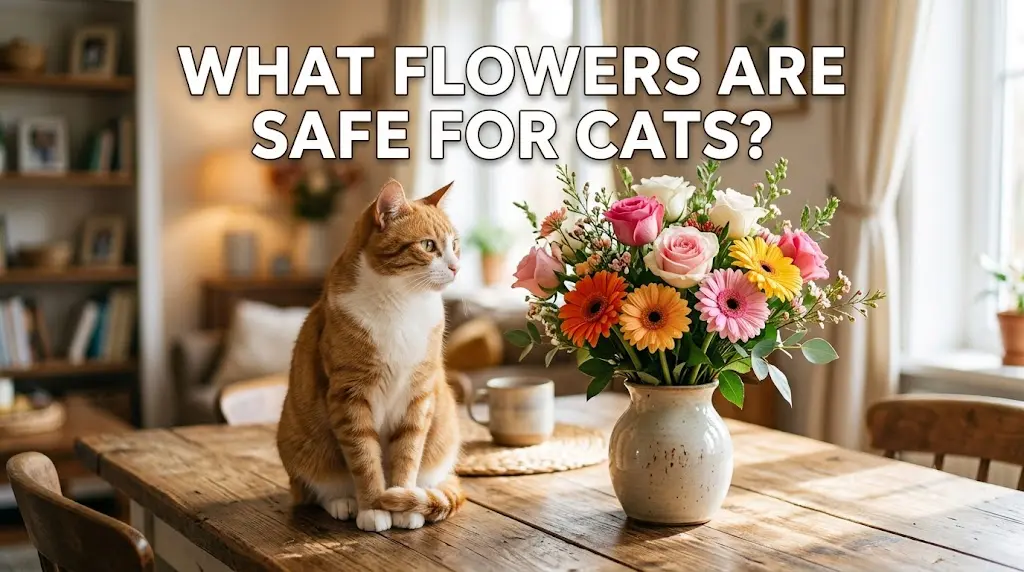
Flowers that are safe for cats include roses, sunflowers, gerbera daisies, orchids, snapdragons, zinnias, asters, freesia, lisianthus, and celosia. These blooms are listed as non toxic by the ASPCA, meaning a curious nibble will not poison your cat.
The flowers to keep out of your home entirely are lilies, which can cause fatal kidney failure in cats from even a lick of pollen or vase water. Tulips, daffodils, hyacinths, azaleas, oleander, and chrysanthemums are also toxic and should never be within reach.
The most common mistake owners make is assuming that placing a bouquet on a high shelf solves the problem. Cats jump, pollen drifts, and dropped petals get found. This guide covers the safe list, the dangerous list, what to do in a poisoning emergency, and how to set up a home where flowers and cats can coexist.
These Flowers Are Safe for Cats and Non Toxic
Every flower listed below appears on the ASPCA non toxic list for cats, meaning ingestion is not expected to cause poisoning. Keep in mind that any plant material can cause mild stomach upset if a cat eats a large amount.
| Flower | Why It Is Cat Safe | Good To Know |
|---|---|---|
| Roses | Petals, leaves, and stems are all non toxic | Strip thorns before displaying to prevent mouth injuries |
| Sunflowers | Fully non toxic including seeds and pollen | Tall stems tip easily, so use a weighted vase |
| Gerbera Daisies | Non toxic and widely available year round | One of the safest florist staples for cat homes |
| Orchids (Phalaenopsis) | Non toxic, long lasting indoor bloom | Excellent choice for permanent indoor displays |
| Snapdragons | Non toxic across the whole plant | Sturdy stems hold up to a curious paw |
| Zinnias | Non toxic garden and cut flower | Great for cat friendly outdoor beds |
| Asters | Non toxic, often used as bouquet filler | Frequently substituted for toxic chrysanthemums |
| Freesia | Non toxic with a strong pleasant scent | Fragrance may deter some cats from chewing |
| Lisianthus | Non toxic and resembles a rose | Popular safe alternative in arrangements |
| Celosia | Non toxic with unusual texture | Texture attracts pawing but poses no risk |
| Statice | Non toxic, works fresh or dried | Dried form stays safe and lasts for months |
| Waxflower | Non toxic common bouquet filler | Safe replacement for baby breath |
| Camellia | Non toxic flowering shrub | Suitable for gardens cats access |
| Petunia | Non toxic bedding plant | Safe for window boxes and patio pots |
| African Violet | Non toxic indoor flowering houseplant | Compact and easy to place safely |
When you order from a florist, ask them to build the arrangement from a cat safe list rather than assuming a mixed bouquet is fine. Most bouquets contain lilies or chrysanthemums as filler even when they are not the feature flower.
Lilies Are the Most Dangerous Flower You Can Bring Into a Cat Home
True lilies and daylilies cause acute kidney failure in cats, and the poisoning can be fatal. This is the single most important thing any cat owner can know about flowers.
Every part of the lily is toxic to cats:
- Petals and leaves
- Pollen that falls onto fur and gets groomed off
- The stem and bulb
- The water in the vase the lilies were sitting in
A cat brushing past a lily and later grooming pollen from its coat has ingested enough to cause damage. There is no safe amount and no safe distance inside a home.
Lily varieties that are dangerous to cats:
- Easter lily
- Tiger lily
- Asiatic lily
- Oriental lily
- Stargazer lily
- Daylily
- Japanese show lily
- Rubrum lily
If you suspect your cat has had any contact with a lily, treat it as an emergency and call your veterinarian or the ASPCA Animal Poison Control Center immediately. Treatment started within the first six hours has a far better outcome than treatment started after symptoms appear.
These Flowers Are Toxic to Cats and Should Be Avoided
The flowers below range from mildly irritating to seriously dangerous. Toxicity level tells you how urgently to act, but none of these belong within reach of a cat.
| Flower | Risk Level | What It Does |
|---|---|---|
| Lily (all true lilies and daylilies) | Severe | Acute kidney failure, often fatal without fast treatment |
| Oleander | Severe | Affects heart rhythm, can be fatal in small amounts |
| Autumn Crocus | Severe | Organ damage, vomiting, bloody diarrhea |
| Lily of the Valley | Severe | Irregular heartbeat and possible seizures |
| Foxglove | Severe | Heart rhythm disruption |
| Azalea and Rhododendron | High | Vomiting, weakness, possible coma |
| Amaryllis | High | Vomiting, tremors, drop in blood pressure |
| Daffodil | High | Severe vomiting, bulbs most dangerous |
| Hyacinth | High | Intense stomach upset, bulbs most toxic |
| Tulip | Moderate to High | Mouth irritation and vomiting, bulb worst part |
| Cyclamen | Moderate to High | Vomiting, heart problems in large doses |
| Calla Lily | Moderate | Painful mouth and throat swelling |
| Chrysanthemum | Moderate | Drooling, vomiting, loss of coordination |
| Hydrangea | Moderate | Stomach upset and lethargy |
| Iris | Moderate | Drooling and vomiting, rhizome most toxic |
| Begonia | Moderate | Mouth irritation and swallowing difficulty |
| Marigold (Tagetes) | Mild | Stomach upset and skin irritation |
| Carnation | Mild | Mild stomach upset and dermatitis |
| Baby Breath | Mild | Vomiting and diarrhea |
| Peony | Mild | Vomiting and drooling |
Marigolds Are Not Safe for Cats Despite Their Reputation
Marigolds are mildly toxic to cats and are listed by the ASPCA as a plant to avoid. They will not cause the organ damage that lilies do, but they are not a cat safe flower.
The confusion comes from two different plants sharing the same common name. Garden marigolds in the Tagetes genus contain compounds that irritate the mouth and stomach, and the sap can cause skin irritation on contact.
Pot marigold, known botanically as Calendula officinalis, is a different plant that is generally considered lower risk. Since most marigolds sold as bedding plants are Tagetes, the safest approach is to treat all marigolds as off limits.
What happens if a cat eats a marigold:
- Drooling and mouth irritation
- Vomiting or diarrhea
- Red or itchy skin where the sap touched
- Loss of appetite for a short period
Symptoms are usually mild and pass within a day. Call your vet if vomiting continues past a few hours or your cat seems lethargic.
Signs of Flower Poisoning in Cats
Symptoms of plant poisoning usually appear within two to twelve hours, although lily poisoning can show signs within one to three hours.
Early Symptoms
- Drooling or foaming at the mouth
- Vomiting or repeated retching
- Refusing food
- Pawing at the mouth or face
- Hiding or unusual quietness
Serious Symptoms That Need Emergency Care
- Increased thirst and urination, then sudden reduced urination
- Tremors, twitching, or seizures
- Difficulty breathing
- Weakness or collapse
- Irregular heartbeat
A cat that suddenly drinks far more water than usual after being near lilies is showing an early kidney warning sign. Do not wait to see if it resolves on its own.
How to Set Up a Home Where Flowers and Cats Coexist
Prevention works better than restriction because a determined cat will reach almost anything. The goal is to make safe options available and dangerous options absent.
Practical Steps
- Buy only from the cat safe list and tell your florist explicitly that you have a cat. Ask them to leave out lilies and chrysanthemums.
- Remove toxic plants from the house completely rather than relocating them to a high shelf. Height is not a barrier to a cat.
- Cover vase openings or use narrow neck vases so your cat cannot drink the water. Vase water holds dissolved plant toxins and floral preservatives.
- Grow a small pot of cat grass or catnip nearby. Cats that have their own greens are far less interested in your arrangement.
- Sweep up fallen petals and pollen daily, because dropped material is where most accidental ingestion happens.
Chewing on plants is usually boredom rather than hunger or dietary need. A cat with a few chew toys it actually likes will generally leave a bouquet alone, especially if the toys are rotated so they stay interesting.
The vase itself is often the real attraction, since cats are drawn to standing and moving water more than to the flowers above it. Putting a running water fountain in the same room usually wins that competition outright and keeps your cat away from water that may hold plant toxins.
Myths About Cat Safe Flowers That Cause Real Harm
| Common Myth | What Is Actually True |
|---|---|
| “Cats instinctively avoid poisonous plants.” | Cats have no reliable instinct for plant toxicity. Many toxic flowers are actively appealing to chew. |
| “Keeping lilies on a high shelf is enough.” | Pollen drifts, petals fall, and cats jump. The only safe approach with lilies is not having them in the home. |
| “Only the flower part is toxic.” | For most toxic species the bulb, stem, leaves, and vase water are equally or more dangerous than the bloom. |
| “A small nibble will not matter.” | With lilies, even pollen groomed off fur can cause kidney failure. Dose does not work the same way across species. |
| “Marigolds are safe because they are used in cooking.” | Culinary calendula differs from garden Tagetes marigolds. Garden marigolds cause stomach and skin irritation. |
| “Dried flowers are always safe.” | Dried toxic flowers keep their toxic compounds. Dried lilies remain dangerous to cats. |
Frequently Asked Questions About Flowers That Are Safe for Cats
What flowers can I have in the house with a cat?
Roses, sunflowers, gerbera daisies, orchids, snapdragons, zinnias, asters, freesia, lisianthus, and celosia are all safe to keep in a house with a cat. These are listed as non toxic by the ASPCA. Always check that bouquet filler does not include lilies or chrysanthemums, since florists add them frequently without mentioning it.
What flowers are 100% cat safe?
No flower is completely risk free, because any plant material can cause mild stomach upset if a cat eats enough of it. That said, roses, sunflowers, gerbera daisies, orchids, and snapdragons are considered non toxic and will not poison a cat. The realistic goal is non toxic rather than perfectly harmless.
What flower is lethal to cats?
Lilies are the most lethal flower for cats. True lilies and daylilies cause acute kidney failure, and exposure to pollen, petals, leaves, or vase water can be fatal. Oleander, autumn crocus, lily of the valley, and foxglove are also potentially fatal. Any lily exposure is a same day emergency.
Which flowers are not toxic to cats?
Flowers not toxic to cats include roses, sunflowers, gerbera daisies, orchids, snapdragons, zinnias, asters, freesia, lisianthus, celosia, statice, waxflower, camellia, petunia, and African violet. When ordering an arrangement, give your florist this list directly rather than asking for something pet friendly, which is interpreted loosely.
What indoor flowering plants are safe for cats?
Orchids, African violets, and Christmas cactus are the best indoor flowering plants for cat households because they are non toxic and thrive indoors long term. Bromeliads and prayer plants are also safe options. Avoid peace lily, which is toxic despite not being a true lily.