
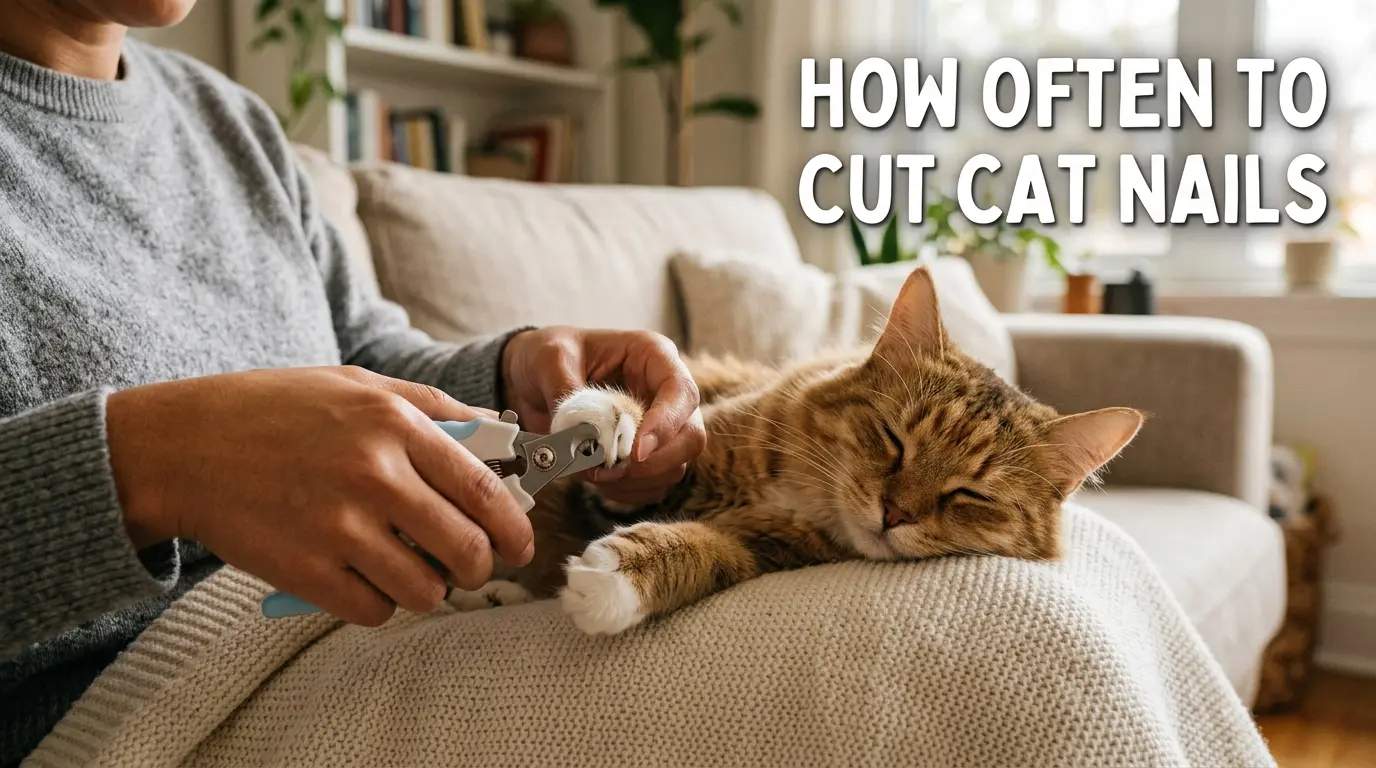
Knowing how often to cut cat nails is one of those things new owners assume they will figure out as they go, and then their cat ends up with claws long enough to snag every blanket in the house. Most cats need a trim every two to four weeks, but the exact timing is influenced by how old your cat is, whether they go outdoors, how much they use a scratching post, and how fast their nails grow naturally.
Before you start, having the right tool makes a real difference, and a reliable set of top rated cat nail clippers will give you clean cuts that reduce the risk of splitting or crushing the nail. If you are working through a first time cat owner checklist, nail care belongs near the top alongside feeding, litter, and vet visits.
One of the most common mistakes cat owners make is either trimming too rarely, which allows nails to curl and cause pain, or trimming too aggressively, which means accidentally cutting into the quick and causing bleeding. Both errors are easy to avoid once you understand what you are looking for.
How Often to Cut Cat Nails: A Schedule by Lifestyle
The right trimming frequency is not one size fits all. It depends on several factors that can push the schedule earlier or later than the general two to four week guideline.
| Cat Type | Recommended Frequency | Why |
|---|---|---|
| Indoor only cat | Every 2 to 3 weeks | No outdoor surfaces to naturally wear nails down |
| Indoor and outdoor cat | Every 3 to 4 weeks | Outdoor activity files nails down partially |
| Outdoor only cat | Every 4 to 6 weeks | Rough terrain keeps nails shorter naturally |
| Kitten (under 6 months) | Every 1 to 2 weeks | Nails grow faster and training is easier young |
| Senior cat (over 10 yrs) | Every 2 to 3 weeks | Nails thicken and curve faster with age |
| Cat with health issues | Check weekly | Some conditions affect nail growth rate |
Cat Nail Anatomy: Understanding the Quick Before You Cut
Before you pick up any clippers, understanding what you are looking at inside a cat’s nail makes a real difference. Cat nails are not solid keratin all the way through. They contain a blood vessel and nerve bundle called the quick, which runs through the center of each nail.
In cats with light or translucent nails, you can see the quick as a pink triangle or cone shape near the base of the nail. In cats with dark nails, the quick is harder to spot, which is why cutting in small increments from the tip is always the safer approach.
| Part of the Nail | What It Is | Why It Matters for Trimming |
|---|---|---|
| The claw/shell | Hard outer keratin layer | The part you cut. Grows continuously. |
| The quick | Blood vessel and nerve inside the nail | Cutting this causes pain and bleeding. Avoid it. |
| The nail sheath | Outer layer that sheds naturally | Cats scratch to remove old sheaths. Normal behavior. |
| The nail bed | Skin at the base of the nail | Do not trim near this area. Always cut just the tip. |
Most importantly, knowing how many nails a cat has helps you work systematically. Most cats have 18 nails total: five on each front paw (including the dewclaw, which sits higher on the leg and never touches the ground) and four on each back paw. The dewclaws on the front paws are particularly important to trim regularly because they never wear down naturally and can curl back into the paw pad if left untreated.
Signs Your Cat’s Nails Are Overgrown and Need Trimming
You do not always need to wait for a scheduled day to check. These signs tell you clearly that it is time to cut:
- Nails clicking or tapping loudly on hard floors or tiles as your cat walks
- Nails snagging or catching on carpet, blankets, clothing, or upholstery
- Visible curving of the nail when you look at your cat’s paw from the side
- Your cat spending more time chewing at their paws than usual
- Redness, swelling, or limping, which can indicate a nail has curved into the paw pad
- Scratch marks appearing higher or deeper than usual on furniture or posts
How to Cut Cat Nails Step by Step
Trimming cat nails does not need to be a stressful event for you or your cat. Following a calm, consistent routine is the most effective way to make it manageable, even with a cat that is not naturally cooperative.
1. Gather everything before you start
Set up in a quiet room with good lighting. You need a pair of sharp cat nail clippers (scissors style or guillotine style), a styptic powder or cornstarch in case you nick the quick, and a small treat to reward your cat after. Having everything within reach means you do not have to leave mid-trim.
2. Choose the right moment
Trim nails when your cat is calm, relaxed, or sleepy. Immediately after a meal or a long nap is often ideal. Never attempt to trim nails when your cat is alert, playful, or already agitated. A relaxed cat makes the entire process faster and safer.
3. Position your cat comfortably
Sit with your cat in your lap or on a stable surface at your height. Wrapping a nervous cat loosely in a towel with one paw exposed at a time, often called the burrito method, can help reduce squirming. Never hold your cat so tightly that they feel restrained or panicked.
4. Extend the nail gently
Hold the paw in one hand and gently press on the top of one toe with your thumb while pushing upward on the pad below with your index finger. This extends the nail without force. Do not squeeze hard or bend the toe at an unnatural angle.
5. Identify the quick before cutting
For cats with light nails, look for the pink triangle near the base of the nail. Cut only the white or translucent tip, leaving at least 2mm of space between your cut and the visible edge of the quick. For dark nails, cut small increments off the very tip and stop when you see a small dark circle appear in the center of the cut surface. That circle indicates you are approaching the quick.
6. Make a clean, confident cut
Position the clipper blades perpendicular to the nail, not at an angle. A straight cut reduces the chance of splitting. Squeeze smoothly and quickly rather than slowly. A hesitant squeeze can crush the nail instead of cutting it cleanly.
7. Work through all nails systematically
You do not need to complete all nails in one sitting, especially with a nervous cat. It is perfectly acceptable to do the front paws in one session and the back paws later, or even to do one or two nails and stop if your cat becomes stressed. Over time, shorter and more frequent sessions teach your cat that nail trimming is not an event to fear.
8. Reward immediately and consistently
Offer a treat or play session immediately after each trimming session, even if you only managed a few nails. Consistent positive association is the most effective long-term tool for building a calm trimming routine.
How to Trim Nails on an Unwilling or Aggressive Cat
Some cats resist nail trimming no matter how calm the environment is. This does not mean you give up. It means you change your approach and work progressively.
Desensitization Over Days and Weeks
- Start by simply touching your cat’s paws during relaxed moments without any clippers present. Do this daily for a week.
- Then introduce the clippers visually. Let your cat sniff them and get used to their presence near the paw.
- Practice pressing the toe to extend the nail without actually cutting. Reward each time.
- Gradually progress to cutting one nail, then stop. Build from there over multiple sessions.
Tools That Help With Resistant Cats
- A pheromone spray on the trimming surface or towel can reduce general anxiety
- Nail trimming bags or wraps designed for cats keep paws accessible while limiting movement safely
- Having a second person hold the cat while you focus only on the nail can divide the task effectively
- Electric nail grinders designed for cats are quieter alternatives to clippers for some cats who react to the clip sound
If your cat is genuinely dangerous to handle for nail trimming despite consistent desensitization efforts, your veterinarian or a professional groomer can handle the task safely. Some cats are sedated for nail trimming at the vet when stress levels are high enough to risk injury. This is a valid and reasonable option, not a failure as an owner.
Indoor vs Outdoor Cats: Why the Trimming Schedule Is Different
The most important single factor in how often to cut cat nails is whether your cat spends time outdoors.
Outdoor cats naturally wear their nails down on rough surfaces like bark, concrete, soil, and rocks. This mechanical filing means their nails stay shorter on their own, and trimming can often be done less frequently. However, this does not mean outdoor cats do not need trimming at all. Dewclaws, which never touch the ground, still grow unchecked regardless of how much outdoor time a cat gets.
Indoor cats have no natural mechanism for filing their nails. Even the most dedicated scratcher using the best scratching post cannot fully substitute for what rough outdoor terrain does to nail length. For indoor cats, regular trimming on a two to three week schedule is the responsible approach to preventing discomfort and protecting your home.
For indoor cats especially, regular trimming on a two to three week schedule is essential. Pair that with the right grooming tools for long haired cats if your cat has a longer coat, since mats near the paw area can make nail checks harder and should be part of the same grooming routine.
Trimming Kitten Nails: Starting Early Makes Everything Easier
Kittens have extremely sharp, needle-like nails that grow quickly. The good news is that kittens are also at the ideal age to learn that nail trimming is a normal part of life.
Start handling a kitten’s paws from the very first week in your home, even if the nails are not yet long enough to trim. Touch each toe, gently press to extend the nail, and reward with gentle praise and treats. This early paw handling builds the foundation that makes nail trimming a non-event as an adult cat.
Kitten nails should be trimmed every one to two weeks due to their rapid growth rate. Use a small, sharp clipper or even human nail scissors for very young kittens, since the nails are thin and fine. As the kitten grows, transition to a proper cat clipper designed for the thicker adult nail.
Common Myths About Cat Nail Trimming
| Myth | The Reality |
|---|---|
| Cats take care of their own nails through scratching | Scratching removes old sheaths but does not shorten nail length. Regular trimming is still necessary for all cats. |
| Outdoor cats never need nail trims | Outdoor activity slows growth but dewclaws never wear down naturally and can curl into the paw pad if left untrimmed. |
| Trimming cat nails damages them | Clean cuts with sharp clippers do not damage nails. Damage occurs from blunt clippers, angled cuts, or cutting too close to the quick. |
| You should only trim when nails are visibly long | Waiting until nails are very long increases the risk of curling, snagging, and accidental quick damage. A consistent schedule prevents problems. |
| Cats hate nail trimming no matter what you do | Cats that are introduced to nail trimming gradually and early typically tolerate it well. Resistance is often a training issue, not an innate feline trait. |
Conclusion
Knowing how often to cut cat nails is the first step toward making nail care a low-stress habit. Most cats do well on a two to four week schedule, with indoor cats typically needing attention closer to every two weeks and outdoor cats able to go a bit longer. Kittens and senior cats both benefit from more frequent attention, and dewclaws need checking regardless of your cat’s lifestyle.
The most important factors to get right are using a sharp clipper, identifying the quick before you cut, and building a calm routine your cat can learn to accept over time. Pairing nail trimming with a full grooming check keeps your cat comfortable, protects your furniture, and gives you a regular window to spot health changes before they become problems.
Every cat is different in how fast their nails grow and how they respond to trimming. When in doubt about technique, nail health, or a cat that resists all handling, your veterinarian or a professional groomer is always the right resource.
Frequently Asked Questions
How often should you cut indoor cat’s nails?
Indoor cats should have their nails trimmed every two to three weeks. Without outdoor surfaces to file their claws naturally, indoor cats’ nails grow longer faster and need more consistent attention.
How long can a cat go without a nail trim?
Most cats can go four to six weeks before nails become problematic, but this varies. Cats with fast-growing nails or no access to scratching surfaces should not go more than three weeks without a check.
What happens if you don’t trim your cat’s nails?
Overgrown nails can curl and pierce the paw pad, cause joint strain, snag on fabric and tear from the base, and damage furniture. In senior cats, nails can embed in the pad silently before signs of pain appear.
How to dull cat’s nails without clipping?
Scratching posts and horizontal cardboard scratch pads file nails down through normal use. Nail caps (soft paws) blunt the tip without cutting. Neither fully replaces trimming but both can extend the interval between clips.
Do vets recommend cutting cats’ nails?
Yes. Veterinarians consistently recommend regular nail trimming as part of routine cat care, particularly for indoor cats. Most clinics offer nail trims as a service for owners who prefer professional assistance.
How do I tell if my cat’s nails are overgrown?
Listen for clicking on hard floors, watch for nails snagging on fabric, and look at the nail profile from the side. A nail that curves visibly downward or touches the paw pad is overgrown and needs attention right away.